4-3-3 Formation
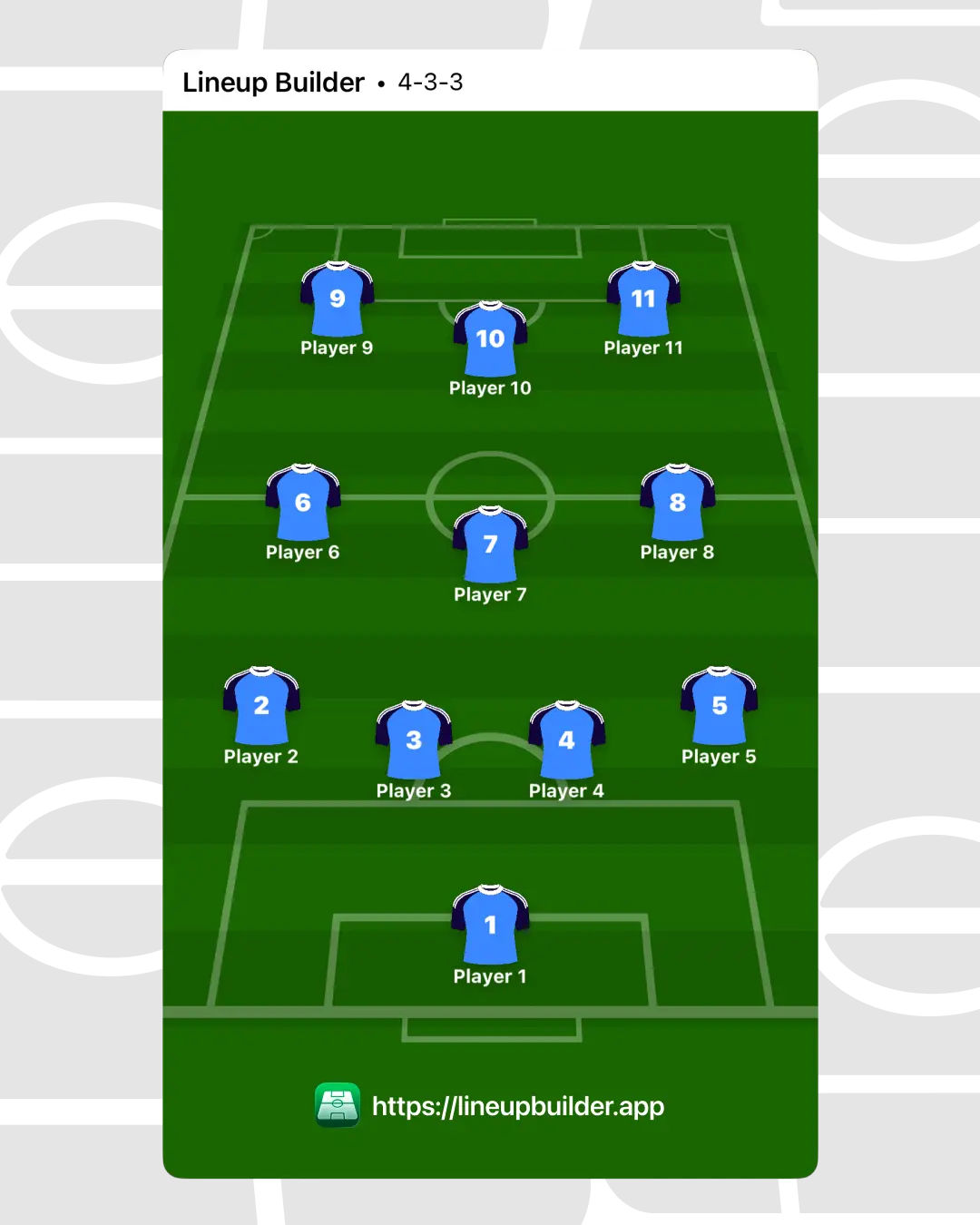
The 4-3-3 football formation (or 4-3-3 soccer formation) is the formation of choice for many of the world's best possession teams. With four defenders, a three-player midfield, and a front three, it combines control in midfield with dangerous width in attack. This guide explains how the 4-3-3 works, its strengths and weaknesses, and how to build it in Lineup Builder.
Key facts
- Players
- 11-a-side
- Defensive line
- Flat back four
- Midfield
- Three players
- Attack
- Two wingers, one striker
- Difficulty
- Intermediate
Overview
When to use it
- Teams that want to control games through possession.
- Squads with fast, skilful wingers and a mobile striker.
- Coaches who want to press high and win the ball back quickly.
- Sides with technical midfielders comfortable receiving under pressure.
Advantages
- A three-player midfield helps dominate possession and central areas.
- Wingers stretch the pitch and create constant one-vs-one situations.
- Excellent for high pressing because the front three can trap defenders.
- Flexible: the midfield three can be set up defensively or offensively.
Disadvantages
- Full-backs must cover huge distances to support the wingers.
- If the midfield is bypassed, the back four can be exposed quickly.
- Requires technically strong players comfortable in tight spaces.
- A lone striker can become isolated if the team drops too deep.
How to set it up
- Set a flat back four with two center-backs and two attacking full-backs.
- Choose one holding midfielder as a pivot in front of the defense.
- Add two more midfielders ahead of the pivot to control the middle third.
- Place two wingers wide and high to stretch the opposition back line.
- Position a central striker to lead the press and finish chances.
Common variations
4-3-3 (Single pivot)
One holding midfielder sits behind two more advanced midfielders, prioritizing attacking control and high pressing.
4-3-3 (Double pivot / 4-2-3-1 hybrid)
Two deeper midfielders provide extra protection, making the shape more defensively secure.
False 9 4-3-3
The central striker drops into midfield to create overloads, dragging center-backs out of position.
Famous teams and contexts
- Barcelona under Pep Guardiola, the modern benchmark for the 4-3-3.
- Liverpool under Jurgen Klopp with their high-pressing front three.
- The Netherlands national team, historic pioneers of the system.
Frequently asked questions
What is the 4-3-3 football formation?
The 4-3-3 football formation (also called the 4-3-3 soccer formation) is a lineup shape used to organise players on the pitch. This guide covers its roles, strengths, weaknesses, and when to use it.
Is the 4-3-3 an attacking or defensive formation?
The 4-3-3 is naturally attacking thanks to its front three, but it is very flexible. With a holding midfielder and disciplined wingers it can also defend in a compact block.
What is the difference between 4-3-3 and 4-4-2?
The 4-3-3 uses three central midfielders and wingers, giving more central control and high-press options, while the 4-4-2 uses two banks of four and two strikers for a more compact, direct style.
Why do full-backs matter so much in a 4-3-3?
Because the wingers often stay high and wide, full-backs must provide defensive cover and overlapping runs, making them some of the hardest-working players in the system.
Do I need technical players for a 4-3-3?
Ideally yes. The system relies on midfielders and forwards who are comfortable receiving the ball under pressure and combining in tight spaces.